
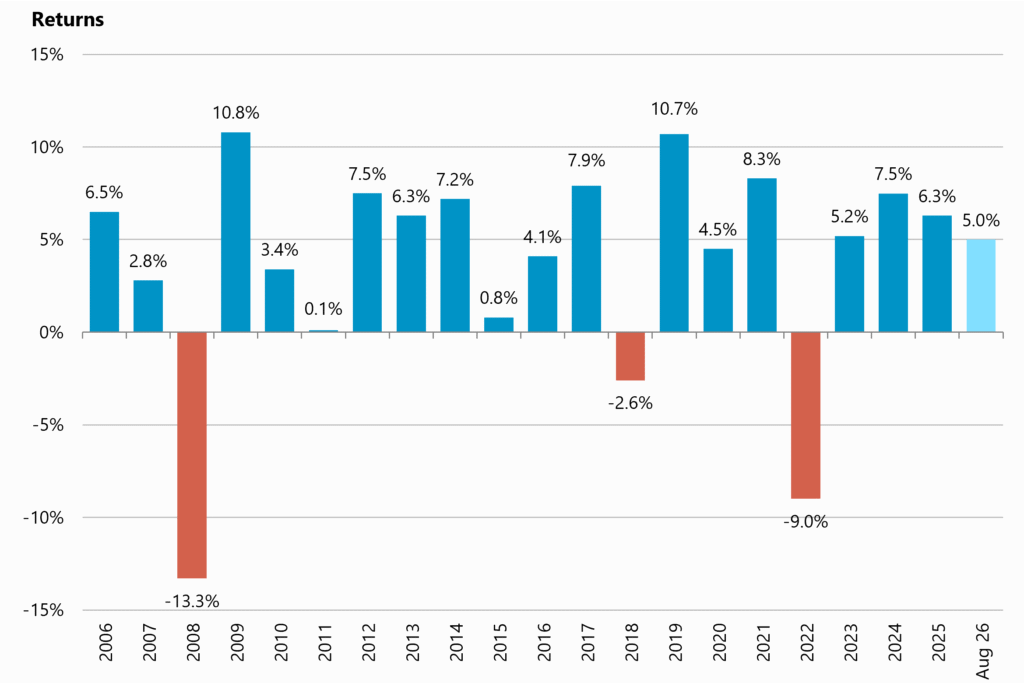
Swiss pension funds achieved an average return of 6.3% last year. The positive result led to a high interest rate of 4.3% on pension capital and an increase in the average coverage ratio to 114.4%. The bond allocation reached a new low, whilst the equities made up the largest share of the portfolio for the second consecutive year. Despite uncertainties, pension funds have continued to record above-average returns to date in 2026.
St.Gallen/Zurich, 8 September 2026
Positive performance and record interest rate
Thanks to the positive performance of the financial markets, Swiss pension funds achieved an excellent average return of 6.3% in 2025. This significantly exceeds the average annual return of 3.6% achieved over the last two decades – despite significant market turbulence resulting from the US government’s tariff announcements. In relation to the total assets of the second pillar (CHF 1,220 billion, Federal Statistical Office; Pension Fund Statistics 2024), this translates to a return of 77 billion Swiss francs It also exceeds the combined contributions of employers and employees of approximately CHF 67 billion in the previous year.
Employees also benefited from the strong returns: their pension capital earned an average return of 4.3% — the highest in 25 years. 99% of pension funds credited an interest rate higher than the minimum set by the Federal Council for the BVG. This is the third time in five years that pension funds have passed on a significant proportion of their investment returns to employees.
Reserves strengthened once again
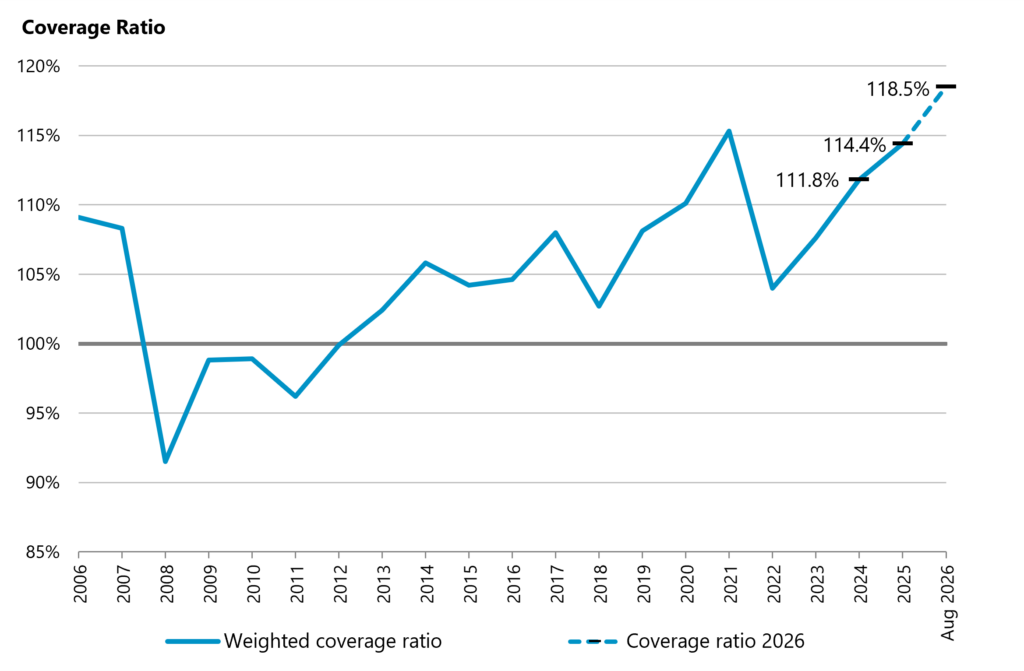
The positive annual result also had an impact on the market fluctuation reserves. The capital-weighted Coverage Ratio rose from 111.8% to 114.4% over the course of 2025. By the end of 2025, only around 2% of pension funds remained underfunded.
Equity allocation rises
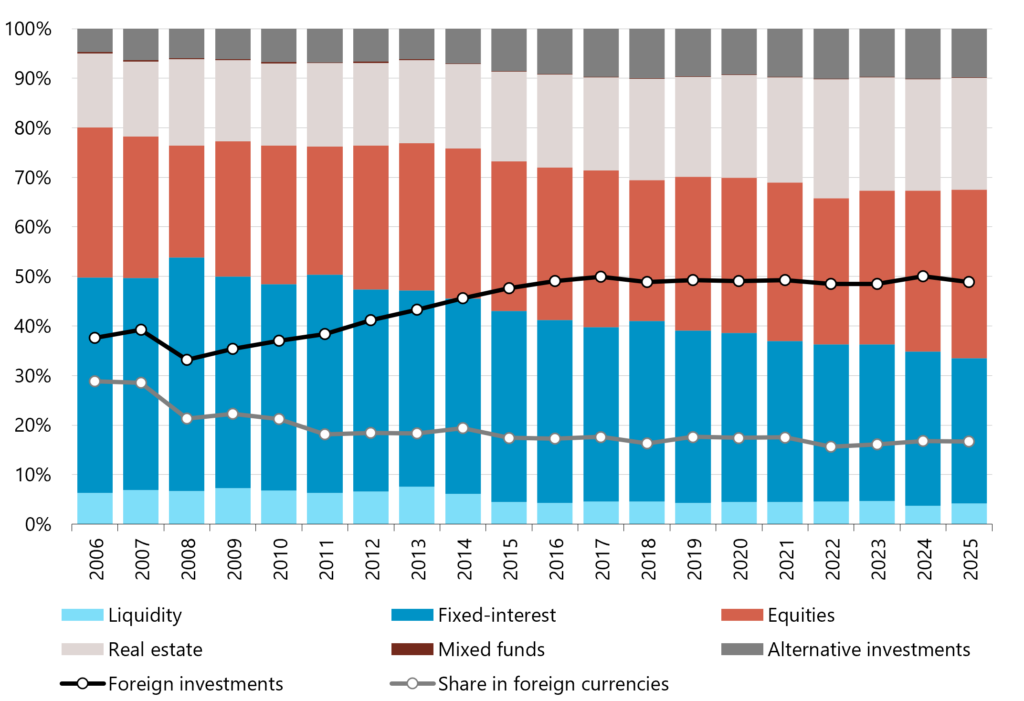
Fixed-income investments were the most significant asset class for Swiss pension funds for many years. When the Risk Check-up study was first introduced more than 30 years ago, nearly half of the portfolio was invested in bonds. Their share has declined steadily ever since, reaching a historic low of 29.3% in 2025. Pension funds reduced investments in global government bonds due to rising government debt and higher hedging costs. The freed-up assets were partly invested in Swiss franc bonds and global corporate bonds. For two consecutive years, equities were the largest asset class, currently accounting for 34.1% of the portfolio. The allocations to real estate (22.6%; +0.1%) and alternative investments (9.8%; -0.3%) have changed very little compared to the previous year.
Infrastructure dominates alternative investments
84% of pension funds invest in alternatives. Its share of the total allocation has hovered around the 10% mark for around 10 years. The mix within alternatives, however, has changed during this period. Whilst hedge funds, among others, used to be dominant within the allocation, infrastructure investments now account for the largest share, representing 2.8 % of total assets or 28% of alternative investments, followed by private equity at 2.4% or 24% respectively.
Rise of illiquid investments
The analysis of Swiss pension funds’ asset allocations over recent decades reveals a significant rise of illiquid investments. This refers to assets which are not tradable, or where trading incurs high costs. Examples include real estate, mortgages and alternative investments. The share of illiquid investments rose from 28.2% to the current 35.7% within 15 years. This increase was driven by the low interest rate environment of the 2010s, as well as the search for new sources of return and opportunities for diversification. The most pronounced increase in allocation has occurred between 2013 and 2017.
Why do pension funds invest in illiquid assets? Diversification is the top priority. For 87% of the funds surveyed, the benefits of additional diversification and the resulting reduction in portfolio risk are a relevant or very relevant decision-making criterion. In addition, 84 % of respondents also value access to additional sources of return.
High illiquidity ratios, however, restrict flexibility. Consequently, pension funds must weigh up the added value of additional illiquid investments against the resulting reduction in flexibility. Roughly one third of the pension funds in the survey have set an explicit cap on illiquid investments. Whilst the majority has not set an explicit cap, the overall illiquidity ratio is nonetheless constrained by considerations regarding flexibility and increasing complexity. 68% and 62% of respondents rate these factors as relevant or very relevant. Other factors limiting the level of the ratio include the structure of liabilities, regulatory requirements and cost considerations.
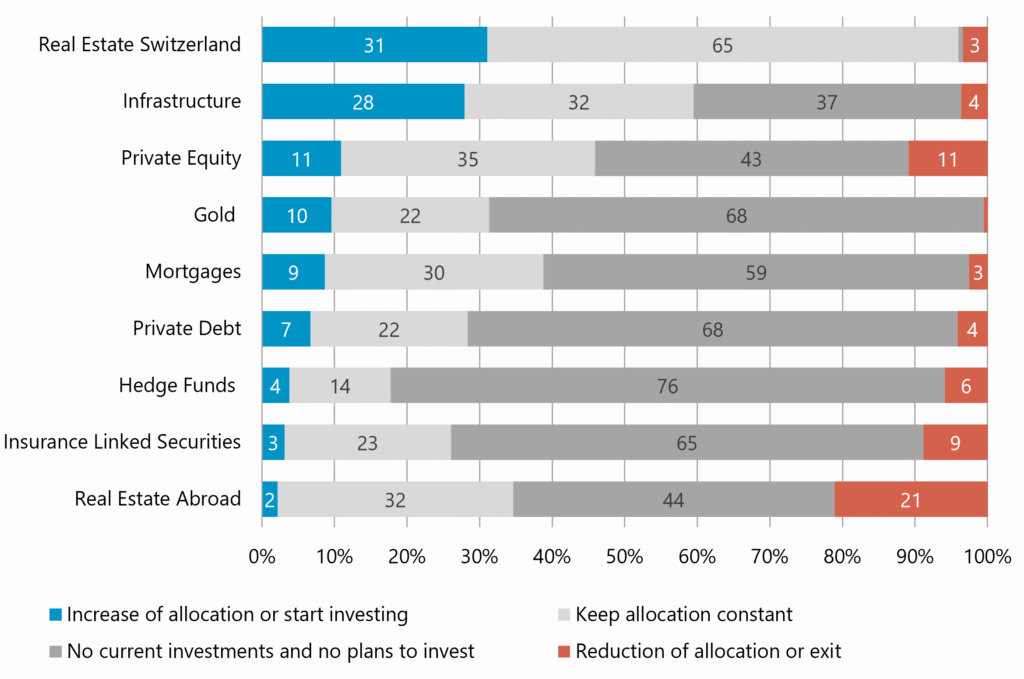
Further expansion of illiquid investments is currently focused primarily on Swiss real estate and infrastructure assets. 31% of respondents stated their intention to increasing their Swiss real estate. As for infrastructure investments, 28% are planning to expand further. However, it is still to be seen whether this will result in an increase of the illiquidity ratio: the survey also reveals that, for example, 21% of respondents intend to reduce foreign real estate assets.
Costs continue to fall
The trend in asset management costs is in line with the long-term trend. In 2025, the 2nd pillar reported their lowest ever total cost ratio to date, at an average of 0.40%. This steady decline is noteworthy given the growth of more cost-intensive asset classes, such as real estate and alternative investments, in recent years. It shows that pension funds continue to keep an eye on asset management costs. Our in-depth, multi-year analysis reveals that low-cost solutions did not lead to higher net returns – just as cost-intensive investments did not translate into higher returns.
Slight decline of technical interest rate
Following a three-year period of moderate increases of the technical interest rate – representing the implicit interest rate commitment to pensioners – the rate fell by -0.05% last year to its current level of 1.75%. Consequently, the value of pension capital and the technical provisions dependent on the technical interest rate increased, which negatively impacted the coverage ratio.
The observed downward trend in conversion rates is continuing to slow. Some pension funds, which previously had lower conversion rates, have even decided the raise the rate slightly. For 2026, the pension funds state report converting the pension capital into a pension at the age of 65 at an average rate of 5.20%. According to the responses of the survey, the rate will only fall marginally in the next five years. Factors that will have a significant influence include interest rate levels and demographic trends, particularly the life expectancy of the insured.
Current situation
Pension funds started the year 2026 with high Coverage Ratios. Despite the volatile market environment, they recorded a return of 5.0% by the end of August and a rise in the Coverage Ratio to 118.5%. Thanks to current reserves and broad diversification within the investment portfolio, the 2nd pillar finds itself in a sound financial position. Provided the financial markets don’t suffer a significant downturn in the remaining months of this year, employees can expect a solid interest on their pension capital in 2026 as well. Perhaps some pensioners might look at a ‘top-up’ from their pension fund in addition to newly introduced the 13th OASI (AHV) pension.
Development of Coverage Ratio (2006 – August 2026)
Performance (2006 – August 2026)
Development of various interest rates (20026 – 2025)

Changes in Asset Allocation (2006 – 2025)
Strategic investment plans for illiquid asset classes
Contact
E-Mail: riskcheckup@complementa.ch
Study Management: Ueli Sutter, Oliver Gmünder, Andreas Rothacher
About the study
The Complementa Risk Check-up Study was carried out for the 32nd time in 2026. The oldest and largest independent pension fund study in Switzerland provides a representative picture of the second pillar on a recurring basis and supplies pension funds and their stakeholders with valuable insights, trends and long-term comparisons. The study team reports on key findings in May and on the overall evaluation and a special topic in September. The study is based on a data set comprising 469 pension funds with total assets of 1,009 billion Swiss francs (a new record for participation) and covers around 80% of pension fund assets. We additionally received responses of 212 pension funds regarding this year’s special topic of illiquid investments and illiquidity risks.
Download: Get a copy of the Complementa Pension Fund Study 2026 (available in German).